Ideas are abundant. Evidence for choosing is not.
Cogni6 turns customer needs, frictions, assets and constraints into innovation territories, comparable concepts and a validation plan.
The client makes one request. The engagement contains three.
Behind the requested deliverable are trade-offs, evidence to consolidate and a decision the consultant must be able to defend.
The workshop produces solutions too quickly
Concepts emerge before needs, alternatives and critical assumptions have been framed precisely.
Novelty becomes the criterion
A compelling idea is not necessarily desirable, feasible, viable or aligned with the organization’s assets.
The validation plan tests too much
Without an assumption hierarchy, the team builds an expensive experiment that fails to reduce the decisive uncertainty.
The same engagement, with an explicit chain of reasoning.
When the work stays fragmented
When Cogni6 structures the engagement
The important engagement returns. So does the thread you must resume every day.
Cogni6 becomes useful well before delivery. It connects the recurring moments when context changes, work resumes and your judgment is required.
Before the client exchange
Find what matters now
Resume the decisions, open questions and next expected outcome without rereading all the engagement material.
After an interview or workshop
Bring in the new context
Add notes, documents and facts to the right file so the next analysis starts from what was just learned.
During production
Move forward without rebuilding the method
Apply the same criteria, controls and roles to recurring work while keeping consequential decisions in your hands.
Before delivery
See what still requires your judgment
Find the evidence, contradictions, assumptions and pending approvals before you stand behind the result in front of the client.
From the client file to a defensible deliverable.
Engagement inputs
Customer research, verbatims, frictions, trends, alternatives, internal assets, economic constraints and innovation ambition.
Work with Cogni6
Cluster needs, frame jobs to be done, build distinct concepts, challenge differentiation and rank assumptions.
Expected deliverables
Opportunity map, value propositions, concepts, selection framework, critical assumptions and validation plan.
What you must be able to verify on this engagement.
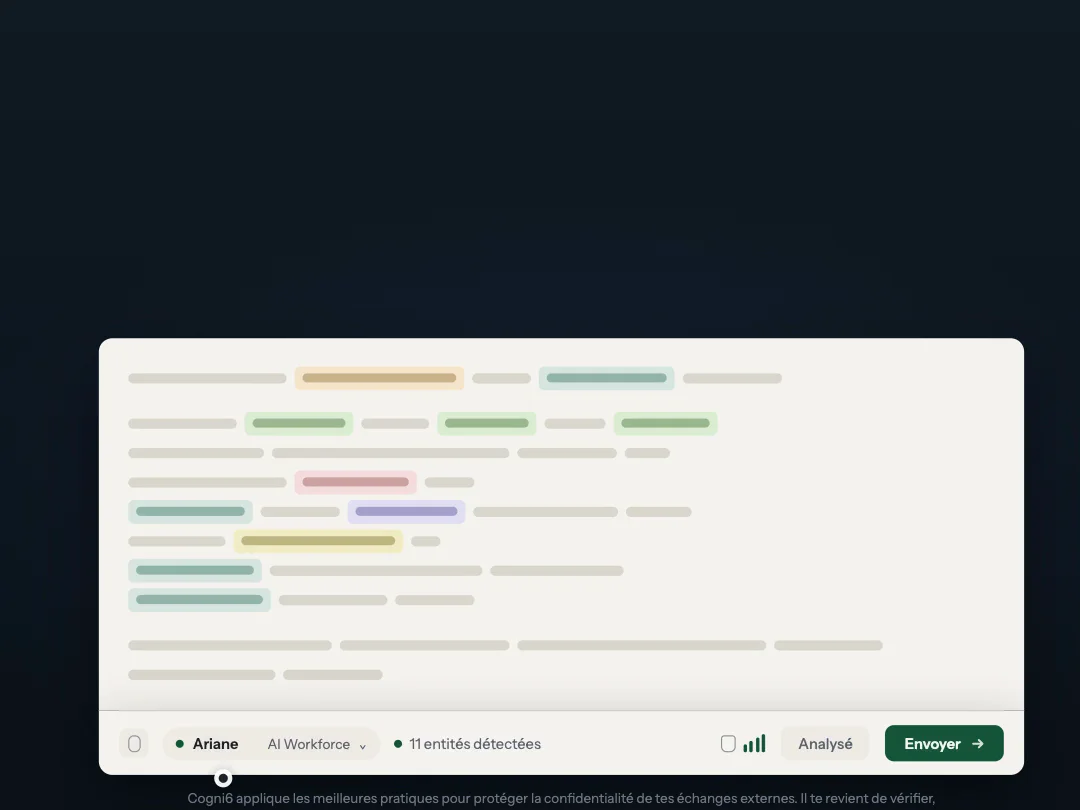
The product view shows the protection applied before sending. The use-case criteria then state what the consultant must be able to review before standing behind the deliverable.
This workflow is part of the current version shown during the guided demo.
Need linked to signals
Every innovation territory returns to observed irritants, behaviours and alternatives.
Comparable concepts
Options are described on the same grid so that the selection can be defended.
Assumptions ready to test
The validation plan targets first what could invalidate the value proposition.
See Cogni6 on an engagement that looks like yours.
Bring an innovation territory, a few customer signals and your selection framework. We will structure the path to a decision.
Request a demoThe demo starts with a 20-to-30-minute conversation and can continue on a real case using synthetic or authorized material.