The recommendation is clear. Execution is not yet.
Cogni6 turns priorities, initiatives, dependencies and decisions into a transformation roadmap that can be governed, measured and revised.
The client makes one request. The engagement contains three.
Behind the requested deliverable are trade-offs, evidence to consolidate and a decision the consultant must be able to defend.
Every initiative is a priority
Workstreams answer to different sponsors and arrive with their own benefits, timelines and constraints.
Dependencies remain implicit
A capability, decision or dataset is missing, but the schedule advances as if every workstream were independent.
Governance follows the org chart
Committees exist without specifying who decides cross-functional trade-offs, at which thresholds and with which evidence.
The same engagement, with an explicit chain of reasoning.
When the work stays fragmented
When Cogni6 structures the engagement
The important engagement returns. So does the thread you must resume every day.
Cogni6 becomes useful well before delivery. It connects the recurring moments when context changes, work resumes and your judgment is required.
Before the client exchange
Find what matters now
Resume the decisions, open questions and next expected outcome without rereading all the engagement material.
After an interview or workshop
Bring in the new context
Add notes, documents and facts to the right file so the next analysis starts from what was just learned.
During production
Move forward without rebuilding the method
Apply the same criteria, controls and roles to recurring work while keeping consequential decisions in your hands.
Before delivery
See what still requires your judgment
Find the evidence, contradictions, assumptions and pending approvals before you stand behind the result in front of the client.
From the client file to a defensible deliverable.
Engagement inputs
Recommendations, initiatives, capabilities, dependencies, constraints, resources, risks, metrics and existing governance.
Work with Cogni6
Connect initiatives and outcomes, prioritize, sequence dependencies, define decision gates and make assumptions measurable.
Expected deliverables
Roadmap, initiative portfolio, sequence, milestones, governance, metrics, risks and decision log.
What you must be able to verify on this engagement.
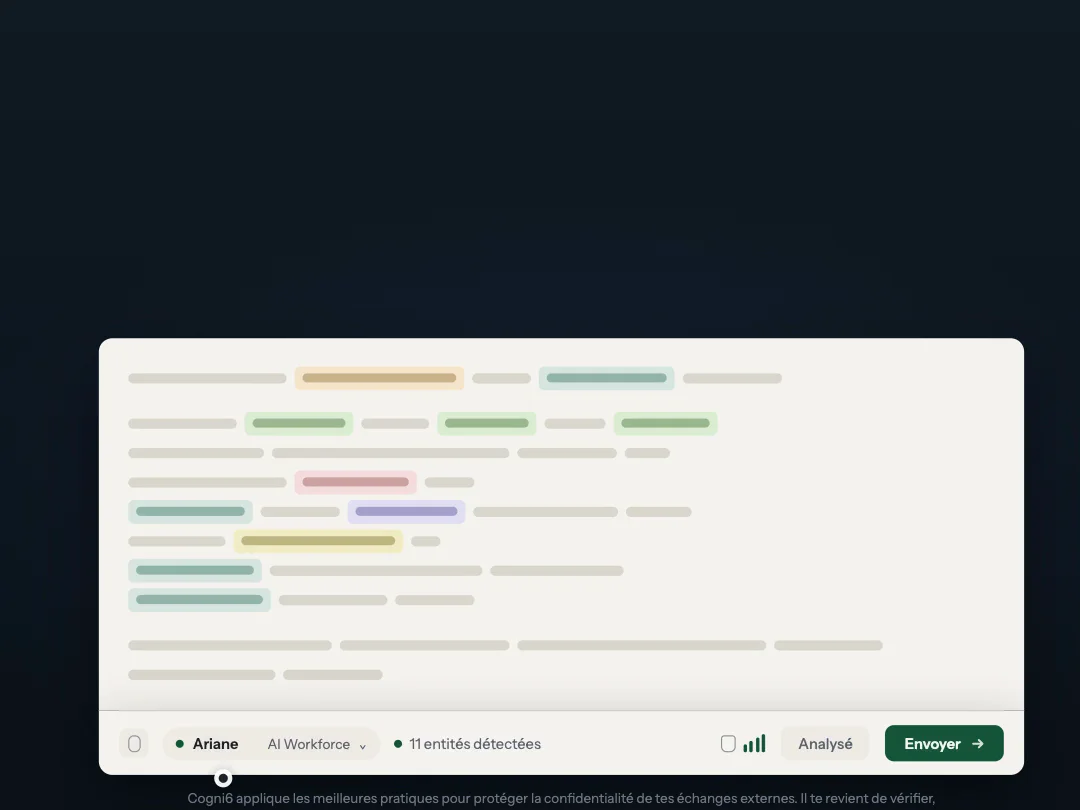
The product view shows the protection applied before sending. The use-case criteria then state what the consultant must be able to review before standing behind the deliverable.
This workflow is part of the current version shown during the guided demo.
Initiatives tied to outcomes
Every workstream carries an expected contribution, dependency and observable indicator.
Dependencies sequenced
Prerequisites and critical decisions appear before they block execution.
Governance that can adapt
The roadmap states who decides, when to measure and how to adjust without losing the record.
See Cogni6 on an engagement that looks like yours.
Bring an existing roadmap or initiative portfolio. We will show how Cogni6 prepares execution and trade-offs.
Request a demoThe demo starts with a 20-to-30-minute conversation and can continue on a real case using synthetic or authorized material.